MEMORY GAP Barberton’s eccentric Charles E.F. Edwards
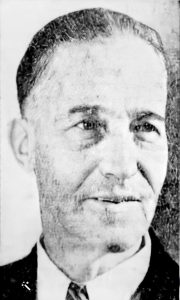
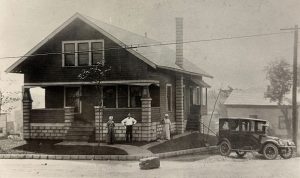
PHOTO COURTESY OF BARBERTON PUBLIC LIBRARY
Charles E.F. Edwards pictured at his home at 401 High Street (887 Wooster Road North), with his mother-in-law Flora Young (left), and his wife Harriet (Young) Edwards (right).
By KARLA TIPTON
BGNN contributor
Barberton once had its very own rich eccentric — Charles E. F. Edwards — an inventor, spiritualist and hoarder.
When Edwards died on Jan. 6, 1950 at the age of 71, he left behind one of the largest estates of Summit County for that year. Estimated at $250,000, the estate had no definitive heirs, since Charles and his wife Harriet had been childless.
It was one of the most complex estates to settle, and the gnarliest.
The home at 887 Wooster Road N was filled with antiques, as well as everything else Edwards had ever owned.
At his death, the headline in the Akron Beacon Journal read, “Maze of Trash Stymies Administrators of Estate” and “Charles Edwards couldn’t bring himself to throw anything away.”
In a newspaper interview nine years earlier, Edwards framed the situation in milder terminology: “As the years have passed, I have acquired many things which were used by early Barbertonians,” he is quoted as saying in a 1941 Barberton Herald article. “The majority of the things that I have in this house have belonged to my family or my wife’s family.”
The Barberton Herald reporter described the contents, including a Jenny Linn bed from the 1850s originally fitted with ropes instead of springs. It had belonged to Harriet’s mother Flora A. Young, but Edwards had taken to sleeping in it.
He also explained that he had purchased items from old homes in Akron.
“This white lampshade is from Colonel Conger’s mansion, the one that is being torn down now; and this one is from Henry Robinson’s home. I also have some things from Miss Augusta Kaiser’s home, the first mansion on High and Exchange Streets in Akron.”
He had a roll-top desk which came from the Barberton Semi-steel Foundry, and a large ceiling to floor mahogany mirror.
“My brother attended the Chicago Exposition in 1893 and brought that mirror to Mother as a gift,” he told the reporter.
The home was also equipped with one of the first telephones in Summit County. The line had originally run from the Young home to his store, a distance of about 400 feet. The device had been patented by Garber, Shaw & Daniels of Chatham Center, Ohio, in 1878.
A MOUNTAIN OF JUNK
When the estate agents went in, they found the home “cluttered with hardware, ornaments, burned-out light bulbs, beer cases, egg crates.”
The basement held old coal heaters, stacks of newspapers, several lawn mowers, lumber and plumbing supplies. Wrote the Beacon, “There were enough tools in the garage to equip an automobile mechanic’s shop.”
An inventor with a mechanical mind, Edwards claims to have invented the first thermostat for a heating device.
“He applied it to a coal furnace years before there was anything of the kind on the market,” explained the executor Edward S. Sheck, “but had never sought a patent.”
Edwards had worked as a mechanic for Andy Auble, Summit County’s first car dealer. He gave up the job in 1916 to manage his real estate business, which he ran from home.
Over the years, he purchased many properties, refurbished them, and sold them for a profit. When the auditors went into the home office, they found the room filled with papers, old tax receipts and deeds to properties. In the roll top desk, there were pigeon holes filled with cigars which Edwards obtained when his father sold his saloon on Broadway and Buchtel in the late 1880s.
Edwards didn’t smoke.
Although not a native Barbertonian, Edwards was quoted in the 1941 article, “I have been connected with the town ever since I courted my wife, a Barberton girl, in 1895.”
YOUNG FAMILY LEGACY
Harriet, who was six years older than Edwards, died in 1933, a year after her widowed mother Flora A. Young. That’s when the property came into Edwards’ possession.
Their unpretentious home at 887 Wooster Road N had been built by Harriet’s father Moritz Young at the intersection of East State Street in New Portage. (The village became absorbed into Barberton shortly after the city’s founding in 1891).
The Young family owned large tracts of land between Tuscarawas River and the Ohio Canal. Because of the several sets of railroad tracks crossing State Street, it became known as Young’s Crossing.
Moritz (aka Morris) Young and his brother Louis Young of Coventry Township were successful businessmen. Their father John had first purchased land in the 1850s at Nesmith Lake, where he operated a tavern that eventually became Young’s Hotel and Restaurant. The structure stood for a century at 2744 Manchester Road in Portage Lakes, until it was razed in 2010.
Additional tracts of Edwards’ property had originally belonged to Harriet’s grandfather, George Strawhecker, who operated the first match factory adjacent to his home in the 1850s — long before O.C. Barber launched Diamond Match Company.
Moritz Young had established a general store and dance hall adjacent to Strawhecker’s land in the 1870s, which served the town of New Portage, and canal boat crews passing through. His neighbor’s daughter Flora A. Strawhecker became his wife.
LOCATION, LOCATION, LOCATION
In addition to the Young property, Edwards owned more than 60 parcels of real estate in Akron, Barberton and Cuyahoga Falls, reported the Beacon Journal. He was heir to his family home, the old John Gross homestead, at South High and Exchange streets. The land had belonged to his late parents, Mark Lukey Edwards and Hannah (West) Edwards. The couple had married and moved to Akron from Butler, Penn., with a large family.
Three of Edwards’ brothers were musicians and one owned a livery stable in Akron’s horse-and-buggy days. Mark and Hannah operated the old Central House, a combination tavern and boarding house, on Broadway. Trouble seemed to follow them, because they were often written up in the newspaper for petty offenses related to selling alcohol, and lawsuits. When Mark Edwards died in 1898, the property went to Hannah, who assumed operations of the boarding house.
In Hannah’s obituary, it was stated that of the eight children she had given birth to, only one was still alive — Charles, who inherited all of it.
Yet there was a dark secret that emerged during the settlement of Charles Edwards’ estate.
His father Mark, a tin miner from Cornwall, England, had abandoned a wife and son when he migrated to Pennsylvania where he married Hannah, and worked as a coal miner. The English son eventually came to America, settling in Alabama, where he fathered several children.
These were among the potential heirs making claims against the Edwards estate.
CONTACTING THE DEAD
Minnie Lucille Browne of Dallas, Texas, the daughter of the half brother Marcus Oliver Ellis (having taken his mother’s surname) represented herself and siblings at Probate Court. She testified of having spent a three-week visit at Edwards’ home many years before, as they traced the family lineage.
Browne testified that Edwards was an “ardent spiritualist.”
“I went to one spiritualist meeting with him,” she said, adding that she had observed Edwards occasionally retire to a dark closet with trumpets, bells and slates. “He expected to communicate with deceased relatives, but while I was there his attempts were failures.”
Edwards apparently wasn’t enamored of the family relationship. In an effort to nip potential financial claims in the bud, he had written his only will in 1916 that bequeathed the cousins only $1 each. It wasn’t until after his mother died in 1924, and his wife in 1933, that he inherited the property making up the bulk of his estate, which is why its settlement became a quagmire.
Attorneys representing about 140 potential heirs were still presenting evidence to the court two years after Edwards’ death.
Claimants included cousins in England and Wales, a common-law wife Katherine Lucas he had acquired after Harriet’s death, and the descendants of the abandoned half brother.
In the end, there were 42 people who inherited, including 15 maternal heirs and 27 paternal heirs, scattered over a distance from the West Coast of the United States to the southwest coast of England. His half brother’s descendants weren’t among the heirs, nor were Harriet Young’s cousins. The common-law wife Katie Lucas took a settlement for $16,000. With it, she started anew, opening Mama Lucas Pizza restaurants on West Waterloo Road and East Hiram Street in Barberton.
After Edwards’ household furnishings and personal effects had been auctioned off in 1952, the Young family home was razed.
Much of what had once been the bustling center of New Portage followed. By the time the State Street bridge opened in 1980, Young’s Crossing was only a memory.