MEMORY GAP Kidnapping, communists, chaos in 1931
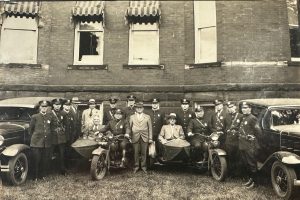
PHOTO FROM BARBERTON PUBLIC LIBRARY
Mayor Seney A. Decker (pictured at center) stands with members of the Barberton Police Department, most who were on duty at the Battle of Lake Anna. Also pictured from left (front row), are officers James Head, Henry Robinson, Byron Eubanks; detectives Jack Baylor and Art Casselberry; officers Charles Johnson and Howard Yackee; sergeant Earl Sellers; officers Lester Bowers, Dean Shannon and George Cole; and sergeant William Dougherty. On the motorcycle and side cars are officer James Whitehead (next to Decker), Chief Fred Werntz and officer Earl McBride.
By KARLA TIPTON
BGNN contributor
Barberton had its share of trouble in 1931.
Crosswinds from multiple directions — political, societal and economic — converged into a perfect storm over the city.
Local historian Micheala Johanson summed it up in a talk at the February meeting of the Norton Historical Society: “For America, it was not the best of times. For Barberton, it was the worst of times.”
Barberton Mayor S.E. Decker stood at the center of the uproar that culminated in what is now called “The Battle of Lake Anna.”
Decker (who went by initials standing for Seney Allen), earned his law degree in Seneca County, but relocated to Barberton in 1903, and became a partner in a local law firm. He ran for mayor and won on the Democratic ticket for his first two-year term in 1920. He was re-elected for second and third terms from 1930-33 during the early years of the Great Depression.
Since the stock market crash in 1929, the city was bleeding jobs from its factories. By the end of 1930, about 14,000 workers had been laid off from the rubber and other local industries in the Akron area. Desperate families suffered from hunger and poverty. The working class felt abandoned. At the same time, the Soviet Union, the world’s first communist state, appeared to avoid the pitfalls of capitalism. People were vulnerable to what seemed like a beacon of hope.
In response, a communist organization called the Unemployed Council of Akron and Kenmore planned to participate in a hunger march through Ohio. The march started on April 16. Groups in Cleveland and Youngstown progressed south and west, planning to meet up in Massillon on their way to Columbus to protest on the unemployment issue.
POLICE ESCORT
There were several communist organizations operating in Northeastern Ohio at the time, including the International Workers of the World (IWW) and the International Labor Defense League. Small cities throughout the area fought to keep the “communist agitators” out of their communities, and Barberton was no exception.
On their route to Massillon, the 125 hunger marchers passed through the city without the option of stopping. They were escorted by all 14 Barberton police officers, 10 off-duty firemen and between 40 and 50 “special” police, members of the local American Legion post, who were deputized for the occasion, according to Barberton history librarian Phyllis Taylor, who later researched and wrote about the incident.
At the same time, other social pressures swirled into the mix. Racial tensions against Black residents increased amidst the poor economic climate. The Ku Klux Klan often held meetings at Lake Anna, floating burning crosses on the lake, gathered on Tuscarawas Avenue viaduct, and gave cross-burning demonstrations throughout the city. Incidents were reported in East Barberton, Johnson’s Corners, the high school athletic field, and North Barberton, wrote historian Taylor. These conflicting forces put “Barberton in the cross hairs,” said Johanson.
Into this volatile mix, a story arose about a 31-year-old African American man named C. Lewis Alexander, who had arrived in Barberton in 1930. For six months, he supported himself by doing odd jobs. He also gave speeches in support of the Communist Party, making a lot of enemies in town.
On the night of Feb. 2, 1931, Barberton police allegedly took him from his straw board hut near Snydertown, gave him a beating and ordered him to leave town. The next day, he took refuge at the home of Hattie Watkins Simpson, who lived in a house adjacent to the National Sewer Pipe factory (where Magic City Shopping Center now stands).
Mrs. Simpson claimed that police forced their way into her house. She filed a petition in Common Pleas Court claiming policemen caused damages of $11,000 and dragged Alexander away.
After that, he disappeared without a trace.
FAKE NEWS
The story began circulating that Alexander had been kidnapped, beaten and murdered by the Barberton police.
The tension in the city ratcheted up. The Barberton Herald reported that telegrams began pouring into Mayor Decker’s office from Youngstown, Cleveland and Toledo, holding the mayor responsible for Alexander’s disappearance.
Because racial tensions were high at the time, the Akron Branch of the National Association for the Advancement of Colored People (NAACP) began looking into it, suspecting foul play. The group made it clear that the NAACP was not at all sympathetic with the communist protests. In May, the group sent a letter to Barberton City Prosecutor asking for a grand jury investigation.
As the case heated up, the communist International Labor Defense staged protest meetings and hurled charges that Alexander had been lynched. Ohio Governor George White acted on demands that the state should investigate the case.
On May 22, Mayor Decker responded to the governor’s inquiry with a statement printed in the Beacon Journal.
“The police department has no record of any such affair,” stated Decker. “The communists of Akron are attempting to saddle something of this character on Barberton because we had nerve enough to keep them on the move when they wanted to hold mass meetings… The next time our attitude may be considerably different.”
On May 27, a group of out-of-town communists held a meeting at the Serbian Hall on Wooster Road North to protest the handling of the Alexander case. Police used tear gas and clubs to break up the meeting, injuring five attendees and slightly injuring two officers. Afterward, Mayor Decker warned all “law-abiding citizens” to stay away from any further communist meetings in Barberton.
Within the next month, the IWW returned to Barberton, asking the mayor if the group could hold a meeting at Lake Anna Park to address the Alexander disappearance. Decker refused, but said they could meet at Edgewood Park, saying, “Nothing but trees to listen to you.”
THE BATTLE OF LAKE ANNA
On June 26, the communist protesters ignored the prohibition of the mayor. According to a 1986 account by Alan J. Simmons who witnessed the event, “a convoy of cars assembled at Lake Anna.”
Mayor Decker took matters into his own hands.
As with the hunger march, he had again authorized the deputizing of former World War I servicemen from the local American Legion chapter, who were issued a badge, a billy club and two tear gas bombs, recalled Simmons.
“Reporters showed up and told they could stay as long as they didn’t take pictures.”
The IWW speakers began to talk, and the reporters put “the cameras to the eyes and the billy clubs came down on the cameras,” he said.
The Battle of Lake Anna was on.
Citizens started battling the communists. As violence erupted, the police, who were prepared for trouble, marched into the fray. Skulls were cracked and tear gas bombs were thrown. Smoke scattered the crowd, inundating houses around the lake and causing injury to bystanders and participants alike.
“The speaker gave up trying to talk as the place was so full of tear gas. People across the lake were affected by it,” described Simmons.
Frank Demshaw, a photographer for the Akron Beacon Journal and a World War I veteran, was battered unconscious by one of the vigilantes, later identified as Harry “Jack” White.
More than 3,000 people witnessed or participated in the disturbance, wrote historian Taylor.
The next day, the Akron Beacon Journal published artist renderings of the me lee, since their cameras had been smashed.
Mayor Decker was accused of condoning vigilantism.
Ohio newspapers and veterans’ groups flooded Governor White’s office with telegrams demanding an investigation.
ORDER IN THE COURT
Grand jury hearings concerning the disappearance of Alexander began. Because the Lake Anna riot was related, it was folded into the investigation. The hearings were held in the old Barberton High School auditorium to accommodate hundreds of public spectators.
Dozens of witnesses gave conflicting testimony about Alexander’s disappearance. One witness claimed he saw two carloads of men in uniform drive to Lime Lake at Columbia Chemical (now PPG) and throw in a box, presumed to contain a body.
Many believed the story had been fabricated and promoted by out-of-town agitators fueling sensational headlines and editorials in the Akron newspapers. The Barberton Herald responded with an editorial that claimed the publicity was designed to induce Gov. George White to remove Decker as the mayor.
BACK FROM THE DEAD
But C. Lewis Alexander wasn’t actually dead.
In July, the investigators discovered that he had been staying in Cleveland with his cousin Moses Peterson since April. Because the news coverage had been local to Barberton, he may not have even known about the hearings, wrote Barberton history librarian Beth Swartz in her Barberton Herald column.
Based on Swartz’s research, when the investigators arrived in Cleveland, Alexander had already left. A letter to his cousin in May indicated he had gone to his mother Alice Alexander’s home in Alabama.
By the time the investigators arrived in Alabama, Alexander had vanished again. Mrs. Alexander believed her son came back to Tuskegee to “get away from places he was being driven away from for his speech making activities.” She suspected that her son left again because he feared what people in the South would do to him if they learned of his communist activities in Barberton.
She said her son had told her he had been arrested, taken to the police station, and ordered to leave the city. He was then taken to the edge of town and beaten up.
The Summit County Prosecutor Don Isham in Akron stated, “Our chief interest was in determining whether Alexander had been murdered or kidnapped. Now that it is disclosed he was neither killed nor abducted, it is not a matter for the grand jury.”
Until Alexander reappeared, the grand jury investigation would be dropped.
The next day, Alexander returned to Akron.
He gave a 53-page statement to Isham claiming he had been beaten several times after being dragged from Mrs. Simpson’s house, both out in the country and at the police station. The police had told him if he left Barberton, they would let him go.
And so he left — bouncing between the homes of acquaintances and relatives from Wadsworth to Cleveland, hopping freight trains to travel, and doing odd jobs to make money. For a while, he was in Pennsylvania working for a coal company. On the way to his mother’s house, he was shocked to come across a Tennessee newspaper column mentioning his disappearance, but continued his trip to Alabama. He had been at his mother’s house for two days when he received a telegram asking him to come back to Akron to testify.
“Didn’t you know that your disappearance caused all this excitement in Barberton?” asked the prosecutor.
“No, I didn’t,” he admitted.
From a lineup in the Finefrock building on Fourth Street in Barberton, Alexander picked out the two officers who had beaten him — J. Byron Eubanks and James Head — from a crowd of 41 men.
THE FINAL ACT
After seven weeks, the Summit County grand jury investigation ended on Aug. 21, 1931.
Over the course of the investigation into the disappearance of C. Lewis Alexander and the riot at Lake Anna Park, more than 100 witnesses had been called to testify.
No Barberton police officers are indicted for the alleged assault of C. Lewis Alexander. The only person indicted was Harry “Jack” White, for assaulting the Beacon Journal reporter Frank Demshaw, and for impersonating an officer. White’s trial took place in November.
The jury found him guilty. He received a 30-day sentence in the county jail and a fine of $50.
After all of that, C. Lewis Alexander vanished again. What became of him remains a mystery.