Letters from the War – Barberton Marine sacrificed life in World War II
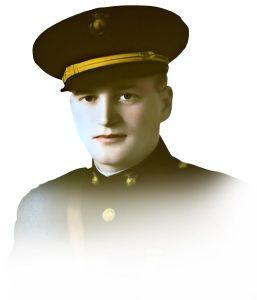
1st Lt. Thomas Haynes Johnson was killed in action during a Marine assault on Japanese positions at Cape Gloucester, on New Britain island, in the South Pacific.
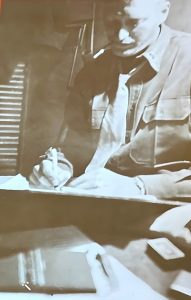
Lt. Thomas Johnson wrote 82 letters home while he was on active duty in the Marines. One of Lt. Johnson’s fellow soldiers snapped this photo of him as he penned one of his many letters home.
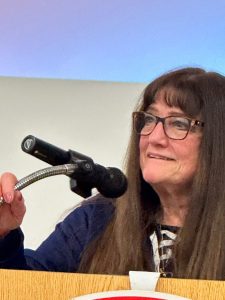
Susan Johnson Parrish, presented an inspirational talk about the military service of Lt. Johnson and that of his two brothers — her uncle, Lt. Richard “Dick” King Johnson (Navy), and her father, Lt. Edward Alfred Johnson (Army Air Corps). Parrish’s speech was featured at the World War II-Korean-Vietnam Wars Veterans Roundtable held at the Kiwanis Community Center in Fairlawn in March.
By KARLA TIPTON | BGNN contributor
We sometimes speak in jest of the hill someone chooses to die on. Sadly, it’s not always a joke. The hill where 1st Lt. Thomas Haynes Johnson lost his life during World War II would come to be known by his fellow Marines as Johnson’s Hill.
On Dec. 30, 1943, the Barberton native was killed in action during a Marine assault on Japanese positions at Cape Gloucester, on New Britain island in what was then the South Pacific territory of Papua and New Guinea.
His niece, Susan Johnson Parrish, presented an inspirational talk about the military service of Lt. Johnson and that of his two brothers — her uncle, Lt. Richard “Dick” King Johnson (Navy), and her father, Lt. Edward Alfred Johnson (Army Air Corps). Parrish’s speech was featured at the World War II-Korean-Vietnam Wars Veterans Roundtable held at the Kiwanis Community Center in Fairlawn in March.
She described the conditions in which her uncle fought his final battle: “They faced daunting conditions, choking rain forests and thick mangrove swamps surrounded by extinct volcanoes in the midst of monsoon season. Besides torrential rains, temperatures in the 90s and above added to the misery.”
Lt. Johnson and his platoon had taken out a Japanese machine gun nest but were still receiving fire, she said.
“Tom forged ahead of his men to locate the source, fired eight times, and took out the nest. While doing so, he was struck by a single bullet, killing him instantly. He was 23 years old.”
For his bravery in battle, he was posthumously awarded the Silver Star Medal, she said.
CHERISHED MEMORIES
She spoke of her grandparents, Frank and Edith Johnson, who lived on E Ford Avenue on Barberton’s east side and saved everything related to the military service of their sons. Frank worked at Babcock & Wilcox, and Edith was a homemaker.
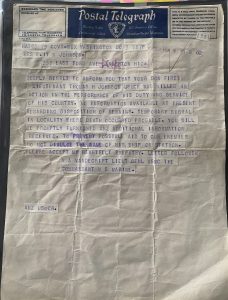
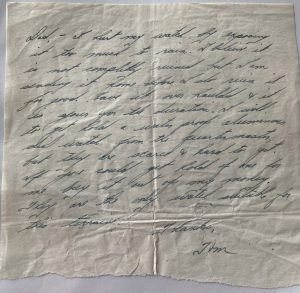
The memorabilia includes 82 letters home from her uncle Thomas, many photos and articles, and letters of condolence from military commanders and comrades in arms. His last letter arrived with a waterlogged watch he had sent home to be repaired. It came the same day as the telegram notifying the family of his death.
Born Jan. 28, 1920, Thomas demonstrated leadership qualities early on. He and his brothers belonged to Boy
Scout Troop 101, sponsored by the First United Presbyterian Church of Barberton. He attended Oakdale Elementary School and graduated from Barberton High School in 1937, where he served as class secretary in his senior year. At a height of 6 feet 2 inches tall, he played center on the basketball team that season.
At Miami University, he continued playing varsity basketball and by the time he graduated in 1942 with a degree in business administration, he had grown three more inches. He was a standout in Beta Theta Pi fraternity, recognized as one of its top athletes.
MAN OF SUBSTANCE
Staff Sgt. Gerald A. Waindel, a Marine Corps combat correspondent, described him after his death using the words of the men who had served with him:
“He was a tall, slim youngster with steady, kind of serious eyes. He was thinking most of the time when he wasn’t reading, and he used to keep running his fingers through his hair. Blond, it was. Sort of an athlete. Always in condition, with a kind of square set to his shoulders. Didn’t joke much.”
Lt. Johnson wrote regularly to his parents, describing his military training in vivid detail.
“I often wish that I had the knack of writing, for I am sure I would produce an interesting book,” he once mused.
His niece is now preserving those wartime memories in a book she began writing five years ago.
“I am very privileged to help him produce this book,” she said of the project, which is in its final stages.
Johnson enlisted in the Marine Corps on March 3, 1942, and was commissioned as a second lieutenant on Oct. 17 of that year. He trained at Marine Barracks Quantico, including amphibious landing exercises on the Potomac River beaches.
“Yesterday we went to the combat area, to see how they make use of the old fortifications, which consist of building tank traps, digging foxholes, and planting barbed wire fences,” he wrote.
“I sure loved the open spaces, and it was loads of fun tramping through the woods these cold, fall mornings. After we got back to the barracks, I thought we would get a chance to rest, but the Marines never get any rest.”
STARSTRUCK
While stationed at Quantico, he enjoyed a USO show featuring movie stars Phyllis Brooks and Jackie Cooper:
“It was the best show I’ve ever seen. After the show, we went down the stairs to the Slop Shop, as we call it, and had a few beers and sandwiches. In a little while, Miss Brooks, the movie actress, came down, and we invited her over to our table. She sat and talked with us for almost half an hour. She had a very pleasing personality, besides being very beautiful.”
After completing training, Johnson was honorably discharged as a private first class to accept his officer’s commission.
He transferred to Camp Elliott in San Diego, where he trained and was processed along with 50,000 other Marines headed to the Pacific. In 1942–43, he was stationed in Australia with the 1st Marine Division at Camp Balcombe, located in Victoria, southeast of Melbourne.
In a letter to his father, he wrote: “Dad, I’ve learned a lot these past few months in respect to my job. It is not routine work, for something new comes up every day. I have never been more happier in my life than I am here in the service. It is my work, my life, you might say. Something I have been seeking for a long time.
“And Dad, I pray every night, not for myself, but for the people back home.”
LONG-DISTANCE ROMANCE
In a letter to his mother dated Aug. 31, 1943, he first mentioned a former classmate and sweetheart, Janis Franz:
“I know I can tell you this, for I believe you always understand me better than anyone else. I believe I’m in love with her, Mother. Sounds funny coming from me, doesn’t it? You and Dad always told me not to get serious, for I have plenty of time.”
Parrish described her uncle’s final contact with home:
“On December 22, 1943, Tom wrote a letter to his parents. Within a week, he would sacrifice his life for his country. In his 23 short years of life, he touched the hearts of many people, and in his death, he broke those hearts.”
“He was a man who truly embodied love of God, country, and family. He was devoted to and was proud to be a United States Marine. A man who was one of the finest examples of the Marine motto, Semper Fidelis.”
A memorial stained-glass rose window honoring Lt. Johnson is installed at Barberton’s First Presbyterian Church, shared with Dr. Floyd Withrow, a Navy chaplain who was also lost in the war.
Lt. Johnson is buried in the American Military Cemetery in Manila, Philippines, alongside 16,859 Americans who died in the Pacific theater. He was one of 310 Marines killed in action during the battles to free New Britain Island.
Parrish shared that her grandparents had a difficult decision to make:
“They had a choice of having him brought home or buried in Manila, and they decided that he should be buried with his men.”
JOHNSON’S HILL
Although the family never visited the battlefield, his childhood friend, Army Staff Sgt. Cleo R. Getz, wrote this reflection:
“I have seen Johnson’s Hill. It is a beautiful hill, sloping gradually skyward from the sea, serene and peaceful now. But everywhere about are evidences that the fierce battle was fought there. Huge bomb craters, trees scarred and broken by shrapnel and shellfire. And undeniably, it towers. The symbol is very gallant. I shall always remember Tom as a small boy, and always the warm friendliness of his smile.”
Her father and uncle returned home from the war, married, and raised families. “But they never forgot their brother,” Parrish said. “My brother Tom is named for him.”