
MEMORY GAP Old Masonic Temple may disappear from downtown landscape
This story appeared in the Dec. 7, 2023 edition of The Barberton Gazette & Norton News. Online subscribers have access to all archived e-editions digitally.
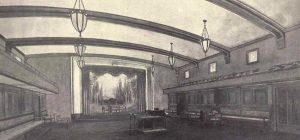
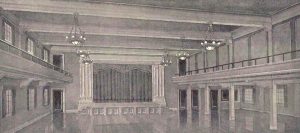
PHOTOS COURTESY OF NATIONAL LODGE
The lodge room of the Masonic Temple, built in the Roman style with arched ceilings and molded beams, as it was pictured in 1925.
The ballroom of the Masonic Temple, built in the classical style and decorated in old ivory, old rose and gray, as it was pictured in 1925.
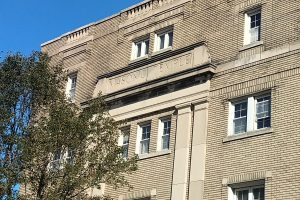
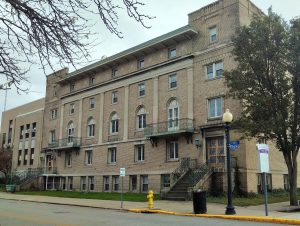
PHOTOS BY KARLA TIPTON
The Masonic Temple building across from Lake Anna was planned by Harpster & Bliss, the same architectural firm that had designed the Barber Mansion.
By KARLA TIPTON
BGNN contributor
In Barberton’s early days, its citizens were “joiners.”
With enthusiasm, they joined civic organizations, lodges, secret societies and clubs. These groups provided their members with ways to promote good works, as well as enjoy fellowship and entertainment. The organizations paved the way for folks to network and advance into society. And perhaps more importantly, members identified with the benevolent concepts upon which these organizations were based.
Over the years, it was the Masonic Temple across from Lake Anna at the corner of Fifth Street NW and W Park Avenue that provided a hub for many meetings and events. More recently, the holiday decorations adorning the front of the building are what people remember. It was the place where attendees to the annual Christmas lighting ceremony could get out of the weather and warm up.
UNCERTAIN FUTURE
This magnificent building has been a cornerstone of the Barberton community since 1925. But as participation in civic organizations fades, so may this important piece of downtown Barberton disappear from the landscape.
According to Richard Landals, National Lodge #568 secretary, declining membership and rising expenses led to the decision to relocate the Lodge to a renovated church complex at 915 W Hopocan Ave.
“For me, and many others, my heart wanted to keep the building going, but my head told me that in order to keep National Lodge No. 568 alive, we needed a more adequate facility to facilitate our existence,” said Landals.
The City of Barberton purchased the building from the Masons in 2022, intending to move the courts into it. The back of the building abuts the municipal complex.
Now, however, it has been determined that the $40 million to make it serviceable for that use is more than the city is willing to spend.
“Really the only thing we can do is raze it,” Mayor William Judge said at the Oct. 2 city council meeting.
A CENTURY PAST
Built for National Lodge #568, F. & A.M. (Free and Accepted Masons), the building’s opulent rooms and halls provided meeting rooms for the Kiwanis, the Rotary Club, the Red Cross and the United Way. In the early years, the Barberton Library Foundation rented the large basement room.
In its spacious auditorium, orchestras and bands performed, and events such as an annual public ball to usher in the New Year, occurred frequently through the 1940s and 1950s.
Members included early city movers and shakers, such as Mayor W.A. Witner; Richard E. Long, superintendent of the Barberton Light and Power District; and Oliver D. Everhard, People’s Bank director and city attorney. The funeral of two-time Barberton Mayor Seney A. Decker, was held there in 1936. By the 1950s, the lodge had 1,000 members.
In the 1920s, when planning for the Temple began, the Magic City had become known as a manufacturing center. Its population increased to 20,000 and civic participation grew right along with it. At that time, membership to the Masons had blossomed to more than 500 members. The organization quickly outgrew its rented West Tuscarawas Avenue premises.
The new building would represent in architecture the Masonry precepts of temperance, fortitude, prudence and justice. It would satisfy all phases of Masonic work, including Royal Arch Masonry and the Order of the Eastern Star. In the early part of 1924, an intensive financial campaign was launched.
National Lodge #568 had existed since 1892 when 15 members living in the Barberton area petitioned the Grand Lodge of Ohio for a dispensation to establish a new lodge, which was constituted in 1894. The first meeting was held in the Moore and St. John Block, and later the Masons established a meeting place in the Tracy Block.
ARCHITECTS
The new Temple would be located on vacant land across from Lake Anna. The location had originally been occupied by the Barberton Inn, a Queen Anne-styled Inn that opened 1895, but was torn down in 1915. This opened up a central downtown block for development.
Harpster & Bliss were engaged as the architects, the firm that had also designed the Barber Mansion.
When the cornerstone was laid on Aug. 25, 1924, more than 5,000 people showed up to watch. A street parade “in which 1,500 Masons marched” wound through downtown Barberton before the ceremony, reported the Akron Beacon Journal. A copper-made time capsule was concealed in the cornerstone.
Built in the Doric style of Renaissance architecture of reinforced concrete and steel, the four-story building faces Park Avenue. It has an exterior of buff face brick and buff limestone trim, with a frontage of 100 feet, with a depth of 68 feet on Fifth Street.
“The many phases of social activities, for which Barberton Masons have always been known, have been cared for in the new temple,” wrote the Barberton News on April 14, 1925.
The completed Masonic Temple proved to be a resounding success.
The Beacon Journal wrote, “Residents of this city on their inspection tours agreed that the temple is one of the finest in the state.”

There is no doubt that is what they said about tearing down the O.C. Barber Mansion ( Cant afford it!) And that was a HUGE mistake!
But it’s not about the preserving the history of the building or some of the history in our town. So no big deal! (NOT)