Norton data center proposal withdrawn
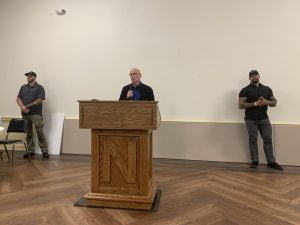
PHOTO BY BOB MOREHEAD | BGNN
Dale James Hobbie, flanked by bodyguards, fields questions from Norton residents on his proposed data center for the former PPG limestone mine.
By BOB MOREHEAD
BGNN senior staff writer
The data center project, intended for the PPG limestone mine, is withdrawn.
Norton City Council President Doug DeHarpart issued a statement Oct. 17 saying that the project is killed, mere days after a contentious town hall meeting where Quantum HPC founder Dale James Hobbie fielded questions from worried residents.
“Following the town hall meeting on Monday, Oct. 13, several council members were provided information from a concerned resident regarding certain statements made by the representative from Quantum HPC,” DeHarpart said. “Council members shared this information with the law director, who asked the developer to determine if the statements were not true. The developer determined the statements were
not true and informed the city that the representative is no longer working for the developer. As a result, the data center project is not moving forward.”
As that representative was the developer’s founder and CEO, Dale James Hobbie, it is unclear on who fired him or how.
At the meeting, Norton resident James Helmick asked Hobbie, founder of Quantum HPC, about
a project in New Mexico and whether he was a defendant in any lawsuits. Hobbie said there’d been no New Mexico project and he’d never been sued.
In fact, Hobbie, a company called Diversified Global System LLC and Arch Insurance had been sued in New Mexico by Integrated Control System Inc. and Steven Chavez in 2023. They’d been contracted to develop land in the Mesa del Sol area of Albuquerque according to required industry specifications. It never happened and the judge concluded the defendants willfully misled in their ability to do so. The day after
Norton’s town hall meeting, the court handed down a $2.9 million judgment against Hobbie, et al., according to court documents.
Helmick also asked about a project in West Virginia. Working through his Silent Partners Group, Hobbie gathered together a couple other companies to form Level5 Data Center Group in 2020 and leased space from Novak WV Properties to build a data center to be used by U.S. government agencies. That project also
never materialized. The New York Supreme Court ordered Gencap Financial Group, along
with a man named Peter Georgiopolis and Hobbie’s wife, Katerina Karvounaki-Hobbie, into
arbitration over the matter, court filings state.
At Norton’s town hall, Hobbie said the West Virginia project fell through because “the landlord wouldn’t sell.”
Hobbie has a long string of floating data center ideas globally, none of which materialized. Silent Partners applied to build three data centers each in Norway and Finland before the pandemic. A 2018 article in Data Center Dynamics declared in a headline, “Lots of ambition, not a lot of detail.”
Reporter Henripekka Kallio, writing for the Finnish newspaper Kaleva, described an eerily similar proposal. The center planned for the Finnish city of Tornio was to generate its own power, using a combination of
natural gas, wind and solar, and recapture the generated CO2. Waste heat in that project would be piped into greenhouses. Kallio asked Hobbie about his educational credentials, listed on his website, and Hobbie declined to respond.
Similarly, Helmick asked Hobbie at Norton’s town hall to verify the credentials; Hobbie told him he could have all the information he wanted if he came to work for him.
Asked about the Nordic projects, Hobbie told the town hall crowd that anti-American bias scuttled them. Kallio’s reporting, however, shows a lack of communication between Silent Partners and local governments and a Norwegian backer, John R. Amundsen, described as a reputable data business operator and developer, told the reporter he hadn’t heard from Silent Partners for many months before the 2019 interview.
The Nordic projects disappeared like smoke. Between then and 2024, Hobbie had floated his data dream in Greece and Australia and again in Norway, but the Finnish articles caused investors to back away.
“Nowadays, people are bombarded with all kinds of scams across all digital channels,” Kallio wrote in 2024. “Most scams are mass-produced using information technology, which makes Data Dale seem like a sophisticated craftsman in comparison. It is quite different to trick elderly people into clicking on a malicious link than to talk millionaires into building giant data centers without any real references.”
Flanked by muscular bodyguards, Hobbie stood in front of the swollen Norton community center Oct. 13 and fielded questions from residents about the proposed gigantic data center. Taking at face value that the proposal was sincere, residents anxiously pitched questions about water and energy, which current data centers ravenously consume, as well as noise, pollution and EMF radiation. Like his Nordic projects,
Hobbie promised an ecological miracle that would generate its own clean power, virtuously noiselessly and capturing emissions. The servers themselves, two stories worth, would be cooled with a closed loop system using water and “food grade” glycol with a few anticorrosives tossed in and somehow not
radiate the transferred heat outside.
“You’ve promised us a magical place,” one resident exclaimed at the meeting.